Artist's Statement Revised (Revised)
We as Humans have an innate habit of organizing and putting things into containers. Everything from jars, buildings, even Earth and the solar system at large, are all environments in which things and experiences exist. The object in which these people, objects, ideas inhabit, is a symbol in itself. The difference between a regular container and a bell jar is enormous and can say a lot about one's social or economic standing in society.
Through the use of bold lines and dramatic color and light, I create a world that is surreal and dream-like. Working mainly with acrylic paints, pencil, watercolor and ink, I want to force the viewer to think about the reality of the world we live in as it relates to these surreal images.
My work has a great deal to do with the concept of micro environments. My interest in contained worlds evolved from a fascination with bird eggs at a very young age. The idea that life is created within a closed shell is astonishing to me. Recently, I did a series of bell jars with mixed media, depicting mini environments within each contained space. Using acrylics, water color and ink, I portrayed historical events and surreal scenes, all dealing with the human struggle. There is a certain tension with power in my work. The subject matter are never fully at ease. I am interested in taking detailed observations from everyday life, human interactions nature and history and isolating them in order to shed light on what life really means.
Thursday, October 6, 2011

Map #6
The Body... and how it relates to my work.
The body, as we have learned, is present in all artistic expression in one form or another. It can exist quite literally in art, through figure drawing, which is a direct representation of the human form as exists in space.
There are also symbolic representations for the body, such as Mona Hatoum's piece titled Corps etranger 1994, which is a video installation. The installation consists of a video, accompanied by recorded sounds of the artists heartbeat and breathing. Viewer's follow as the camera pans the body, and eventually penetrates the interior of the stomach, intestines and vagina through various orifices. Another artist, Robert Gober, has a piece Untitled (1990), in which he has covered as bag with beeswax, pigment and human hair to resemble a man's hairy torso.
As you can see, there are many ways in which contemporary artists explore the theme of the body. I had the challenge of relating the topic of the body to my own work. I would say that my own work deals very much with the body in a spiritual sense. Of course, I represent the body very close to how it exists in real-life, through photo realistic paintings. But I also deal with the body through personal journey, in the form of enlightenment, rebirth, death and evolution. For example, I had completed a recent body of drawings, paintings and mixed media (ink and water color) portraying bell jars with mini worlds inside of them. In one of my paintings, I dealt with rebirth. The image was a black cut-out silhouette of a bell, mounted on top of white paper, with a detailed painting inside of the sihouetted bell jar. I depicted a dead zebra at the bottom of the bell jar, with a man rising (being born) from the dead carcass. From the man a group of colorful butterflies dance above him. All of the species are moving in the direction of the top of the bell jar, which has a sprouting seed and a rainbow beaming from it. This piece deals with the theme of rebirth and the concept that all dead things give back energy to the world. It is the natural cycle of life.
I would say that I choose to depict the form as close to real as I can, but in surreal spiritual situations.
The body, as we have learned, is present in all artistic expression in one form or another. It can exist quite literally in art, through figure drawing, which is a direct representation of the human form as exists in space.
There are also symbolic representations for the body, such as Mona Hatoum's piece titled Corps etranger 1994, which is a video installation. The installation consists of a video, accompanied by recorded sounds of the artists heartbeat and breathing. Viewer's follow as the camera pans the body, and eventually penetrates the interior of the stomach, intestines and vagina through various orifices. Another artist, Robert Gober, has a piece Untitled (1990), in which he has covered as bag with beeswax, pigment and human hair to resemble a man's hairy torso.
As you can see, there are many ways in which contemporary artists explore the theme of the body. I had the challenge of relating the topic of the body to my own work. I would say that my own work deals very much with the body in a spiritual sense. Of course, I represent the body very close to how it exists in real-life, through photo realistic paintings. But I also deal with the body through personal journey, in the form of enlightenment, rebirth, death and evolution. For example, I had completed a recent body of drawings, paintings and mixed media (ink and water color) portraying bell jars with mini worlds inside of them. In one of my paintings, I dealt with rebirth. The image was a black cut-out silhouette of a bell, mounted on top of white paper, with a detailed painting inside of the sihouetted bell jar. I depicted a dead zebra at the bottom of the bell jar, with a man rising (being born) from the dead carcass. From the man a group of colorful butterflies dance above him. All of the species are moving in the direction of the top of the bell jar, which has a sprouting seed and a rainbow beaming from it. This piece deals with the theme of rebirth and the concept that all dead things give back energy to the world. It is the natural cycle of life.
I would say that I choose to depict the form as close to real as I can, but in surreal spiritual situations.
Map #5
Time - Reframing the Present
Our class has already discussed several themes in Contemporary Art, including identity and the body. For this weeks reading of Themes of Contemporary Art: Visual Art after 1980, we learned about the various ways in which contemporary artists deal with time.
For my portion of the reading I looked closely at the section Reframing the Present. Here are a few of the artists discussed:
Kara Walker
Best known for her gallery-sized tableaux of black cut silhouettes on a white background wall, which examine the undertones of American racial and gender tensions. Originally born in Stockton, California, Walker moved to a suburb of Atlanta at age 13. Her work is layered with references from literature, historical events, and culture. Walker strives to make viewers think about the way in which history is represented affects race dynamics today.


+Atul+Dodiya-1.jpg)


Our class has already discussed several themes in Contemporary Art, including identity and the body. For this weeks reading of Themes of Contemporary Art: Visual Art after 1980, we learned about the various ways in which contemporary artists deal with time.
For my portion of the reading I looked closely at the section Reframing the Present. Here are a few of the artists discussed:
Kara Walker
Best known for her gallery-sized tableaux of black cut silhouettes on a white background wall, which examine the undertones of American racial and gender tensions. Originally born in Stockton, California, Walker moved to a suburb of Atlanta at age 13. Her work is layered with references from literature, historical events, and culture. Walker strives to make viewers think about the way in which history is represented affects race dynamics today.

One of India's most sought after contemporary artists, Dodiya incorporates a mix of both Western art, and the history and culture of India. He has created paintings on the corrugated metal exteriors of roll up doors that have been removed from actual shops in India. The paintings on the exteriors celebrate India's history, depicting figures such as Gandhi. The doors then raise to expose surreal paintings of events.
Art critic John Brunetti remarked:
"These hidden images are stark portrayals of an India very different from that presented by Gandhi's non violent resistance." (134)
Dodiya, much like Walker, expresses how celebratory versions of history cease to acknowledge the issues that exists presently.

+Atul+Dodiya-1.jpg)
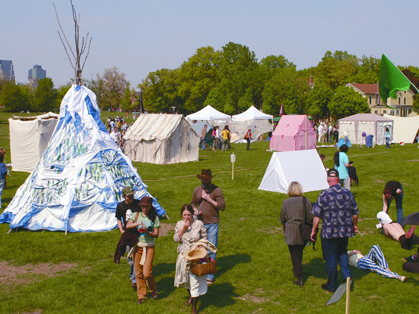
Smith examines historical reenactments, with works such as The Munster (2005). This piece was a public art project which mixed the aesthetics of Civil War reenactment with contemporary artistic expression. She invited fifty individuals and collaborative groups to build campsites at Fort Jay on Governor's Island in New York City, making costumes, banners, flags and installations intended to celebrate anything anyone was fighting for.
Artists also, deal with revisiting their own personal histories, as discussed in the passage. Artist Tracey Emin's installation, Everyone I Have Ever slept With 1963-1995 (1995), is a tent embroidered with the names of all the people Emin had ever shared a bed with over the past three or so decades.
Subscribe to:
Posts (Atom)