For our task, we were each given assignments which were created by artists. Each one was a small task which involved an onsite performance art piece. I was given the task of creating a wishing tree. This was inspired by Yoko Ono's 1981 piece titled Wish Tree. Here's a picture of my roommate below, filling out a wish on a scrap of paper:
-MP
Tuesday, November 29, 2011
Tuesday, November 15, 2011
Map # 11
Elizabeth Leech Gallery: Lee Kelly and Bonnie Bronson Exhibit Review
Upon viewing this exhibit in early October, I did some background research on both artists in the exhibition, Lee Kelly and Bonnie Bronson. This allowed me to gain a better perspective on both them as artists as well as people. The following is information and review on both the artists and the work chosen for the Elizabeth Leech exhibit.
Lee Kelly – Maquettes – New work
Lee Kelly is an especially important artist in the context of contemporary sculpture in the northwest, and for that matter the country. Kelly has been a prominent member of the Portland art community for over 50 years and counting. I discovered that Kelly is also an avid traveler, which often influences his work. He has traveled to places such as Mexico, Tibet, Japan, Nepal, New Zealand as well as various other locations.
Kelly is best known for his monumental sculptures, which bring life to public spaces around Portland and the country. Lee began his artistic journey as a painter. In 1959 he graduated from the Museum Art School at the Portland Art Museum, which is no known as the Pacific Northwest College of Art. It is interesting to think of the ways in which is earlier practices as a painter have influenced his iconic sculptures of recent times.
The exhibit, titled Maquettes, provides an interesting experience that is beyond the ordinary for Lee Kelly’s work. The exhibition consists of eleven total pieces; nine smaller ones that sit on pedestals and two large ones that tower above the viewer on the ground. The pieces are, for the most part smaller, and in many cases studies for larger sculptures. They stand out on white pedestals sprinkled around the room. This is especially effective in showing the shear number of smaller studies Lee made in preparation for his large works, the ones that get the most attention from the general public. I went to Lee’s one man show a year ago in 2010, hosted by the Portland Art Museum, and I was able to witness the diversity Kelly has in his work. The pieces in the Portland Art Museum were wide-ranging, some using recycled materials, others dauntingly large and made out of industrial steel. This Elizabeth Leech show shows a softer, more poetic side of Kelly, and most importantly his artistic process. What I believe the gallery was trying to achieve with this show was for the most part accomplished; The process Lee Kelly takes in order to create massive sculptures for park settings. The sculptures occupy the gallery like poetic symbols. It’s as if, lining all of the works up in a line, there would be specific message the artists were trying to convey. I do think that the ration of small to large sculptures is appropriate. The power of the smaller pieces in a way is ‘larger’ than that of the big ones. I especially enjoyed the study for Henry Ford at Delphi (2009). The piece is shown below:
This piece was less polished than some of the other pieces in the show, and I thought, was a great example of process. It also had Lee Kelly’s signature circles and lyric-like lines. I sometimes think that smaller sculptures can be better studies, since larger ones often times are daunting in scale and difficult to take in at one viewing.
In comparison to the smaller pieces, the large ones are much more polished, again showing the process Kelly took from the concept for a piece to a study and then finally to the final piece. In the smaller pieces, the shapes are not as easy to make out, whereas in the larger ones the shapes are much more definite and distinct in relation to one another, creating a simple harmony. Here is one of the two larger pieces shown in the exhibit, titled Nepal II (2011):
As a whole I thought Lee Kelly’s exhibit was successful in communicating to the viewer the process the artists takes in order to create his pieces he’s so well known for. He does not simply create a large sculpture for a public space in one go.
Bonnie Bronson – The Early Years – Painting, sculpture, and works on paper
I was not aware of artist Bonnie Bronson’s work until I visited this collection. Bronson was apparently an important and highly respected Portland, OR-based sculptor who worked with and across several media. Much like Lee Kelly, Bronson’s work is displayed publically both locally and nationally. Bronson’s pieces are displayed in several public institutions throughout the Northwest.
Bonnie Bronson was born in Portland, OR in 1940 and attended the Portland Art Museum School (now PNCA), as did Kelly. This exhibit was quite appealing because it offered a glimpse at two northwest artists who are both widely acclaimed and established and both went to the same institution for education and training. Both artists are similar in style and way they use sculpture in more lyrical and flowing manner.
Bronson’s part of the exhibit was titled The Early Years, because it was compromised of pieces she made upon graduating as a young artist from Portland Art Museum School. These pieces show the birth of her signature style as a artist.
The show is exhibits a series of paintings and sculptures that have been painted. The paintings are abstract washes of paint that are essentially “action paintings”. Here is one Untitled (turquoise) (1962-63):
In harmony with that piece is a sculpture that hangs from the wall, Untitled (Large White Construction) (1965):
Both pieces use paint loosely and in a way that is explorative. It is interesting to compare both Kelly’s and Bronson’s sculptural pieces. Both use curves and angles in a way that creates dynamic pieces. Bronson has the addition of color in the form of paint on her sculptures. Kelly’s pieces are much more dimensional as well.
All in all, this exhibit was a strong example of two Portland-based artist’s work. They both have similar qualities to their pieces, but are also unique in their own right.
-Matt
Thursday, November 10, 2011
Monday, October 17, 2011
Map # 9
Bio Art
Bio art is art made by artists who use living organic materials (i.e. bacteria, cell lines, molecules, plants, body fluids and tissues, and even living animals).
Brief History of Bio Art:
Chauvet Cave
Oldest cave paintings known to exist, based off radiocarbon dating.
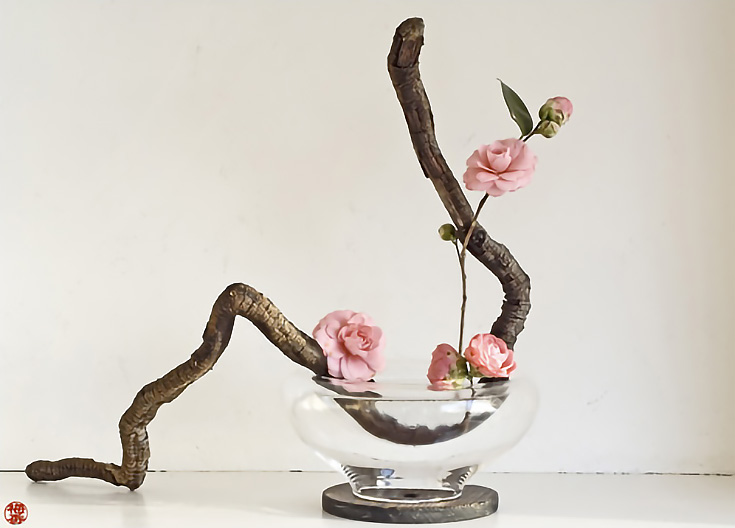
Ikebana
Japanese art of flower arrangement, dating back to the 7th century. Employs minimalism, with an
emphasis on shape, line and form. Silence is practiced.
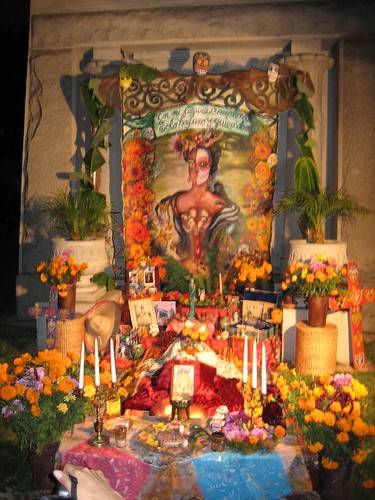
Dia de los Muertos
Private altars built by people of mexican decent to honor the deceased. Lavishly decorated with
flowers, food and other small offerings.
Recent precursors to Bio Art... The earth artists of the 60s and 70s.
Robert Smithson - Sprial Jetty - 1970
The entire piece is made of mud, salt crystals, basalt rocks, earth and water.
Betsy Damon - The Living Water Garden - 1998
Chengdu, China. Park and organic system that purifies water.
George Gessert - Origin
Orogin is a breeding project involving streptocarpuses, a genus of plants grown
for their ornamental flowers.
New additions...
Marilee Salvator - Red Rover, Red Rover - 2004
Menstrual fluid monotypes, silkscreen. Salvator ran tampons through an etching press. Concepts dealing with sexuality, femininity and abuse.
Gregory Euclide - Untitled (Bon Iver cover art) - 2011
Acrylic, buckthorn root, dirt, found foam, geranium, moss, mylar, paper, pencil, photo transfer,
pine cone, desum, snow, sponge. 35 x 35 x 6.
Cheers!
-M.
Tuesday, October 11, 2011
Map #8
Language - Wielding the Power of Language
Artists often use words in their work, not only for aesthetic reasons, but also adress political issues. Sucj political and social issues include:
-environment
-violence
-nuclear warfare
-sexism
-racism
-... as well as many other heated topics of present day.
More and more artists are finding language to be a powerful tool when impacting the viewer.
Artists have many ways of conveying messages through language. Here's a sample of a few artists:
ACT UP (Aids Coalition to Unleash Power)
The Girl Effect Video
Artists often use words in their work, not only for aesthetic reasons, but also adress political issues. Sucj political and social issues include:
-environment
-violence
-nuclear warfare
-sexism
-racism
-... as well as many other heated topics of present day.
More and more artists are finding language to be a powerful tool when impacting the viewer.
Artists have many ways of conveying messages through language. Here's a sample of a few artists:
ACT UP (Aids Coalition to Unleash Power)
Holzer challenged the gallery distrubution system.
Jean Michel Basquiat
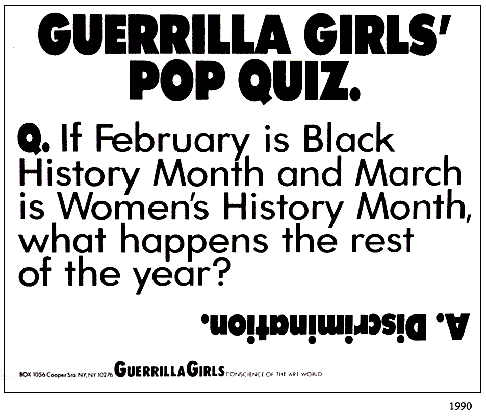
A collective established in New York in 1985. They use street posters printed with statistics and brief text to bring attention to issues such as discrimination against women and censorship. They use text rhetorically to influence the thoughts and actions of their audience.
His political messages are a bit more indirect.
Untitled (I Am Not Tragically Colored) 1990
Scott deals with censorship and power of authority to conrtol what we read and how it is portrayed.
Bonus: Here's a powerful + short ad campaign the GIRL EFFECT created (using text!):
Thursday, October 6, 2011
Map #7
Artist's Statement Revised (Revised)
We as Humans have an innate habit of organizing and putting things into containers. Everything from jars, buildings, even Earth and the solar system at large, are all environments in which things and experiences exist. The object in which these people, objects, ideas inhabit, is a symbol in itself. The difference between a regular container and a bell jar is enormous and can say a lot about one's social or economic standing in society.
Through the use of bold lines and dramatic color and light, I create a world that is surreal and dream-like. Working mainly with acrylic paints, pencil, watercolor and ink, I want to force the viewer to think about the reality of the world we live in as it relates to these surreal images.
My work has a great deal to do with the concept of micro environments. My interest in contained worlds evolved from a fascination with bird eggs at a very young age. The idea that life is created within a closed shell is astonishing to me. Recently, I did a series of bell jars with mixed media, depicting mini environments within each contained space. Using acrylics, water color and ink, I portrayed historical events and surreal scenes, all dealing with the human struggle. There is a certain tension with power in my work. The subject matter are never fully at ease. I am interested in taking detailed observations from everyday life, human interactions nature and history and isolating them in order to shed light on what life really means.
We as Humans have an innate habit of organizing and putting things into containers. Everything from jars, buildings, even Earth and the solar system at large, are all environments in which things and experiences exist. The object in which these people, objects, ideas inhabit, is a symbol in itself. The difference between a regular container and a bell jar is enormous and can say a lot about one's social or economic standing in society.
Through the use of bold lines and dramatic color and light, I create a world that is surreal and dream-like. Working mainly with acrylic paints, pencil, watercolor and ink, I want to force the viewer to think about the reality of the world we live in as it relates to these surreal images.
My work has a great deal to do with the concept of micro environments. My interest in contained worlds evolved from a fascination with bird eggs at a very young age. The idea that life is created within a closed shell is astonishing to me. Recently, I did a series of bell jars with mixed media, depicting mini environments within each contained space. Using acrylics, water color and ink, I portrayed historical events and surreal scenes, all dealing with the human struggle. There is a certain tension with power in my work. The subject matter are never fully at ease. I am interested in taking detailed observations from everyday life, human interactions nature and history and isolating them in order to shed light on what life really means.
Map #6
The Body... and how it relates to my work.
The body, as we have learned, is present in all artistic expression in one form or another. It can exist quite literally in art, through figure drawing, which is a direct representation of the human form as exists in space.
There are also symbolic representations for the body, such as Mona Hatoum's piece titled Corps etranger 1994, which is a video installation. The installation consists of a video, accompanied by recorded sounds of the artists heartbeat and breathing. Viewer's follow as the camera pans the body, and eventually penetrates the interior of the stomach, intestines and vagina through various orifices. Another artist, Robert Gober, has a piece Untitled (1990), in which he has covered as bag with beeswax, pigment and human hair to resemble a man's hairy torso.
As you can see, there are many ways in which contemporary artists explore the theme of the body. I had the challenge of relating the topic of the body to my own work. I would say that my own work deals very much with the body in a spiritual sense. Of course, I represent the body very close to how it exists in real-life, through photo realistic paintings. But I also deal with the body through personal journey, in the form of enlightenment, rebirth, death and evolution. For example, I had completed a recent body of drawings, paintings and mixed media (ink and water color) portraying bell jars with mini worlds inside of them. In one of my paintings, I dealt with rebirth. The image was a black cut-out silhouette of a bell, mounted on top of white paper, with a detailed painting inside of the sihouetted bell jar. I depicted a dead zebra at the bottom of the bell jar, with a man rising (being born) from the dead carcass. From the man a group of colorful butterflies dance above him. All of the species are moving in the direction of the top of the bell jar, which has a sprouting seed and a rainbow beaming from it. This piece deals with the theme of rebirth and the concept that all dead things give back energy to the world. It is the natural cycle of life.
I would say that I choose to depict the form as close to real as I can, but in surreal spiritual situations.
The body, as we have learned, is present in all artistic expression in one form or another. It can exist quite literally in art, through figure drawing, which is a direct representation of the human form as exists in space.
There are also symbolic representations for the body, such as Mona Hatoum's piece titled Corps etranger 1994, which is a video installation. The installation consists of a video, accompanied by recorded sounds of the artists heartbeat and breathing. Viewer's follow as the camera pans the body, and eventually penetrates the interior of the stomach, intestines and vagina through various orifices. Another artist, Robert Gober, has a piece Untitled (1990), in which he has covered as bag with beeswax, pigment and human hair to resemble a man's hairy torso.
As you can see, there are many ways in which contemporary artists explore the theme of the body. I had the challenge of relating the topic of the body to my own work. I would say that my own work deals very much with the body in a spiritual sense. Of course, I represent the body very close to how it exists in real-life, through photo realistic paintings. But I also deal with the body through personal journey, in the form of enlightenment, rebirth, death and evolution. For example, I had completed a recent body of drawings, paintings and mixed media (ink and water color) portraying bell jars with mini worlds inside of them. In one of my paintings, I dealt with rebirth. The image was a black cut-out silhouette of a bell, mounted on top of white paper, with a detailed painting inside of the sihouetted bell jar. I depicted a dead zebra at the bottom of the bell jar, with a man rising (being born) from the dead carcass. From the man a group of colorful butterflies dance above him. All of the species are moving in the direction of the top of the bell jar, which has a sprouting seed and a rainbow beaming from it. This piece deals with the theme of rebirth and the concept that all dead things give back energy to the world. It is the natural cycle of life.
I would say that I choose to depict the form as close to real as I can, but in surreal spiritual situations.
Map #5
Time - Reframing the Present
Our class has already discussed several themes in Contemporary Art, including identity and the body. For this weeks reading of Themes of Contemporary Art: Visual Art after 1980, we learned about the various ways in which contemporary artists deal with time.
For my portion of the reading I looked closely at the section Reframing the Present. Here are a few of the artists discussed:
Kara Walker
Best known for her gallery-sized tableaux of black cut silhouettes on a white background wall, which examine the undertones of American racial and gender tensions. Originally born in Stockton, California, Walker moved to a suburb of Atlanta at age 13. Her work is layered with references from literature, historical events, and culture. Walker strives to make viewers think about the way in which history is represented affects race dynamics today.
Our class has already discussed several themes in Contemporary Art, including identity and the body. For this weeks reading of Themes of Contemporary Art: Visual Art after 1980, we learned about the various ways in which contemporary artists deal with time.
For my portion of the reading I looked closely at the section Reframing the Present. Here are a few of the artists discussed:
Kara Walker
Best known for her gallery-sized tableaux of black cut silhouettes on a white background wall, which examine the undertones of American racial and gender tensions. Originally born in Stockton, California, Walker moved to a suburb of Atlanta at age 13. Her work is layered with references from literature, historical events, and culture. Walker strives to make viewers think about the way in which history is represented affects race dynamics today.
One of India's most sought after contemporary artists, Dodiya incorporates a mix of both Western art, and the history and culture of India. He has created paintings on the corrugated metal exteriors of roll up doors that have been removed from actual shops in India. The paintings on the exteriors celebrate India's history, depicting figures such as Gandhi. The doors then raise to expose surreal paintings of events.
Art critic John Brunetti remarked:
"These hidden images are stark portrayals of an India very different from that presented by Gandhi's non violent resistance." (134)
Dodiya, much like Walker, expresses how celebratory versions of history cease to acknowledge the issues that exists presently.
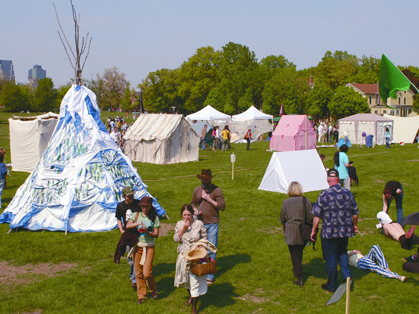
Smith examines historical reenactments, with works such as The Munster (2005). This piece was a public art project which mixed the aesthetics of Civil War reenactment with contemporary artistic expression. She invited fifty individuals and collaborative groups to build campsites at Fort Jay on Governor's Island in New York City, making costumes, banners, flags and installations intended to celebrate anything anyone was fighting for.
Artists also, deal with revisiting their own personal histories, as discussed in the passage. Artist Tracey Emin's installation, Everyone I Have Ever slept With 1963-1995 (1995), is a tent embroidered with the names of all the people Emin had ever shared a bed with over the past three or so decades.
Thursday, September 29, 2011
Map #4
Artist Statement (Revised):
We as humans have an innate habit of organizing and putting things into containers. Everything from jars, buildings, even Earthm, are all environments in which things and experiences exist. The object in which these things inhabit, is a symbol in itself. The difference between a bell jar and cabinet is enormous.
My work has a great deal to do with the concept of microenvironments. My interest in contained worlds evolved from a fascination with bird eggs at a very young age. The very idea that life is growing within a contained shell is astonishing to me. Recently, I did a series of bell jar environments. Using an assortment of media, including acrylics, watercolor, and ink I portrayed instances in history, both minor and major, all dealing with the human struggle. There is a certain power tension to my work. The subjects are never at ease. The many juxtapositions that exist in this world are fascinating to me and I want to use contrasts, whether it be between people, environments, animals or stylistic choices, in order to shed light on social, environmental and political issues that exist.
Through the use of bold lines and dramatic use of color and light, I create a world that only exists in my imagination, but sheds light on the world around me. The main mediums I've worked with are acrylics and ink. In the future, I'd like to use a more eclectic range of mediums. Above all, I'd like to make some type of impact on a viewer's way of thinking or seeing the world.
Thursday, September 22, 2011
Map #3
Rhizome / a continuously growing horizontal underground stem that puts out lateral shoots and
adventitious roots at intervals.
As I develop my own style and themes in the process my thesis, its been useful (maybe vital) putting my work in the context of contemporary art.
While reading the introduction to Themes of Contemporary Art: Visual Art After 1980, British artist Keith Tyson's work resonates greatly with me. Prior to Tyson's introduction in the chapter, the term rhizome is briefly explained. The term was used by French philosophers Gilles Deleuze and Félix Guarttari in there book titled A Thousand Plateaus: Capitalism and Schizophrenia. Rhizome was used:
"to describe nonhierarchical knowledge networks that allow multiple entry and exit points." (32 Robertson and McDaniel)
The term was borrowed from the botanical term for a continuously growing horizontal underground stem that puts out lateral shoots and adventitious roots at intervals. Deleuze and Guattari used the term to describe research that has no apparent beginning or end, resists rigid orginization and dominating ideas and can connect heterogeneous elements. The World Wide Web is used as a prime example of a rhizomatic model.
Keith Tyson's epic installation titled Large Field Array (2006-07), is another prime example of a rhizomatic model. The installation or sculpture is comprised of three hundred moduar units, of which a majority were created using polystrene. The cube units are spaced in a grid along the gallery flooring and walls. Each cube references something different, varying from science to pop culture to history. Large Field Array proposes that:
"everything can be linked without the control or singularity of a hierachical structure." (32 Robertson and McDaniel)
As I delve into developing my thesis, the Rhizome Theory is something that I keep coming back to. I am interested in exploring the connections between events, both minute and major. Everything in this world is connected even if it may not appear as so. The instantaneous nature of technology and our attention span creates memories that are mixed and matched and a world that may only exist between our ears.
adventitious roots at intervals.
As I develop my own style and themes in the process my thesis, its been useful (maybe vital) putting my work in the context of contemporary art.
While reading the introduction to Themes of Contemporary Art: Visual Art After 1980, British artist Keith Tyson's work resonates greatly with me. Prior to Tyson's introduction in the chapter, the term rhizome is briefly explained. The term was used by French philosophers Gilles Deleuze and Félix Guarttari in there book titled A Thousand Plateaus: Capitalism and Schizophrenia. Rhizome was used:
"to describe nonhierarchical knowledge networks that allow multiple entry and exit points." (32 Robertson and McDaniel)
The term was borrowed from the botanical term for a continuously growing horizontal underground stem that puts out lateral shoots and adventitious roots at intervals. Deleuze and Guattari used the term to describe research that has no apparent beginning or end, resists rigid orginization and dominating ideas and can connect heterogeneous elements. The World Wide Web is used as a prime example of a rhizomatic model.
Keith Tyson's epic installation titled Large Field Array (2006-07), is another prime example of a rhizomatic model. The installation or sculpture is comprised of three hundred moduar units, of which a majority were created using polystrene. The cube units are spaced in a grid along the gallery flooring and walls. Each cube references something different, varying from science to pop culture to history. Large Field Array proposes that:
"everything can be linked without the control or singularity of a hierachical structure." (32 Robertson and McDaniel)
As I delve into developing my thesis, the Rhizome Theory is something that I keep coming back to. I am interested in exploring the connections between events, both minute and major. Everything in this world is connected even if it may not appear as so. The instantaneous nature of technology and our attention span creates memories that are mixed and matched and a world that may only exist between our ears.
Large Field Array, 2006-07
Check out Keith Tyson's web page for more of his fanciful work.
Thursday, September 15, 2011
Map #2
Artist Statement
I aim to represent the human state, in its many facets of being. The dynamic nature of every living being is so complex and layered that it is hard to understand who we are and why we are here. Through the use of visual tecchiques such as painting and scultpure, I hope to at least break the surface of who I am intrinsically, how I relate to others and how we all fit into the grander scheme of this planet. In studying cultures, history, nature and the human condition I am able to have a better grasp on reality as it appears to me.
Life is constantly in motion, evolving to suit the ever-changing needs of our planet. So is my work and vision. There is no clear beginning or end to my images, they are all part of the greater narrative of our universe.
I aim to represent the human state, in its many facets of being. The dynamic nature of every living being is so complex and layered that it is hard to understand who we are and why we are here. Through the use of visual tecchiques such as painting and scultpure, I hope to at least break the surface of who I am intrinsically, how I relate to others and how we all fit into the grander scheme of this planet. In studying cultures, history, nature and the human condition I am able to have a better grasp on reality as it appears to me.
Life is constantly in motion, evolving to suit the ever-changing needs of our planet. So is my work and vision. There is no clear beginning or end to my images, they are all part of the greater narrative of our universe.
Self Portrait, 2005
Map #1
Tiffany Bozic
Grew up on a farm in Arkansas and was always interested with the intricacies of nature. Her work incorporates highly saturated pigments of acrylics on maple wood panels. Bozic is said to be inspired by John James Audubon and Ernst Haeckel. Theses selections are deeply surreal and stunning...
Silent Dredge, 2008
Under My Skin, 2010
The Best Intentions, 2005
For more of Tiffany Bozic's work and a biography, visit here.
Kehinde Wiley
An LA born and New York based visual artist, Wiley has cemented himself in the long history of portraiture painting. He takes traditional notions and blurs them within contemporary modes of representation. Socio-political histories of oppression are at the forefront of Wiley's heroic images of urban black youth...
Ice T, 2005
Triple Portrait of Charles I, 2007
Three Graces, 2005
To find more of Wiley's Portraits, check this out.
Keith Haring
Was born on May 4, 1958 in Reading Pennsylvania. Haring developed a passion for drawing at a very young age, acquiring cartoon skills from his father and picking up on the pop culture aesthetics of Dr. Seuss and Walt Disney. During a very brief but rich career, Haring stamped himself as one of the most influential artists of the late twentieth century. Here are a few iconic images..
Knokke, 1987
Untitled, 1988
The Last Rainforest, 1989
Haring's work is expansive, this is only a taste of his world.
Subscribe to:
Posts (Atom)


+Atul+Dodiya-1.jpg)